Home / Blog / Healthcare Quality
Healthcare Quality
Healthcare Accreditation Coordinator Jobs: Follow the Readiness Cycle
Accreditation work is not a pre-survey document scramble. The coordinator turns standards into observable practice, tests that practice, and follows gaps through correction.
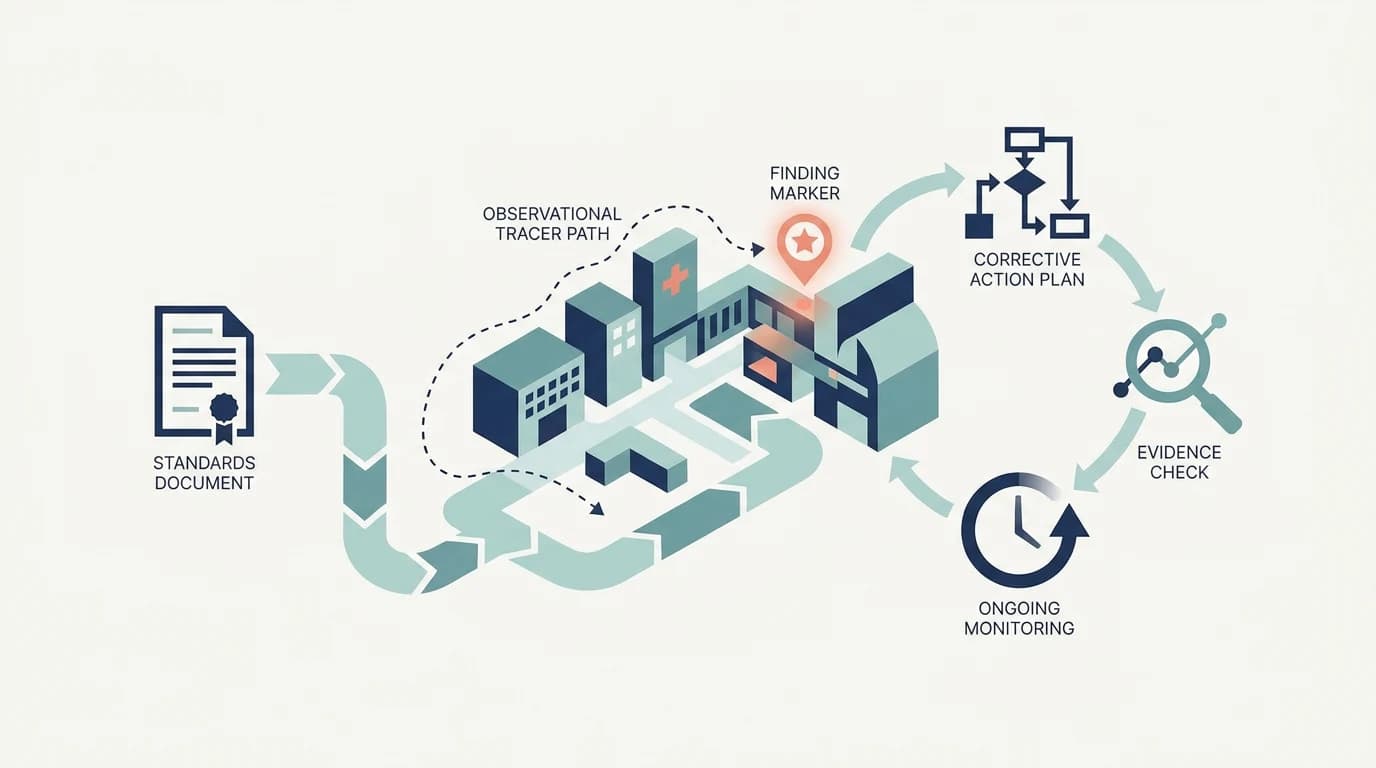
Follow the role through one readiness cycle
A useful way to read an accreditation coordinator posting is to follow six connected outputs: a standards crosswalk, a readiness check, documented findings, an assigned corrective action, evidence that the change was implemented, and monitoring that tests whether it holds. UC Health's current posting carries this cycle across regulatory updates, mock surveys, tracers, gap closure, staff education, dashboards, action-plan tracking, and leadership reporting. A vacancy that owns only calendars and evidence collection is different from one that interprets standards, tests practice, and challenges whether a correction is sustainable.
A tracer tests the care path, not the binder
The Joint Commission describes tracer methodology as following a patient's experience through the care delivery process to identify problems within steps and at the interfaces between them. Individual tracers use an actual care experience as the frame; system tracers examine connected processes and communication across departments. For candidates, tracer language signals work beyond document control. Look for observation, staff interviews, medical-record review, handoff testing, environmental checks, and the ability to connect one finding to the relevant requirement without turning the exercise into coaching staff toward a scripted answer.
Separate the coordinator's work from the surveyor's judgment
CMS says hospital deficiencies must be based on violations supported by observations of actual performance or practice. The internal coordinator can interpret requirements, organize evidence, conduct mock tracers, report risk, and help a department build a corrective action, but does not replace the regulator or accrediting body's determination. This boundary matters when reading verbs. “Track” and “prepare” suggest coordination; “interpret,” “audit,” and “facilitate” suggest broader readiness work; “determine compliance” may describe delegated internal authority, but should be tested carefully in interview questions about final decision rights and escalation.
Decode the posting by its dominant work product
A standards-and-policy role spends more time mapping changing requirements to policies and operational owners. A tracer-and-audit role spends more time in departments observing work, reviewing records, and documenting findings. A corrective-action role maintains issue logs, owners, due dates, evidence, retesting, and leadership escalation. An education-and-readiness role builds briefings, tools, and staff practice for continuous readiness. Current UC Health and University of Kansas Health System postings combine these lanes but weight them differently; Kansas explicitly includes in-person tracers, medical-record audits, standards interpretation, action plans, education, and survey scribe duties. Requirements also vary, so do not infer that one clinical degree, license, or certification is universal from the title alone.
Build an interview example around a closed finding
Prepare a non-confidential example that begins with a requirement or observed gap and ends with retesting. Show what evidence exposed the issue, who owned the practice, how the finding was written, what corrective action was agreed, what proof showed implementation, and how recurrence was monitored. Be exact about your authority: coordinating evidence is not the same as approving the response, and facilitating a tracer is not the same as making an external accreditation decision. Compare this role with the broader quality improvement coordinator guide and healthcare compliance coordinator guide. Then review current healthcare administration jobs and set job alerts for accreditation, regulatory readiness, survey readiness, and quality compliance titles.