Home / Blog / Revenue Cycle
Revenue Cycle
Revenue Cycle Career Path: Entry Points, Specialties, and Next Moves
Revenue cycle is not one job ladder. It is a connected set of front-end, mid-cycle, and back-end roles, with several practical ways to move across it.
Start by locating your work in the cycle
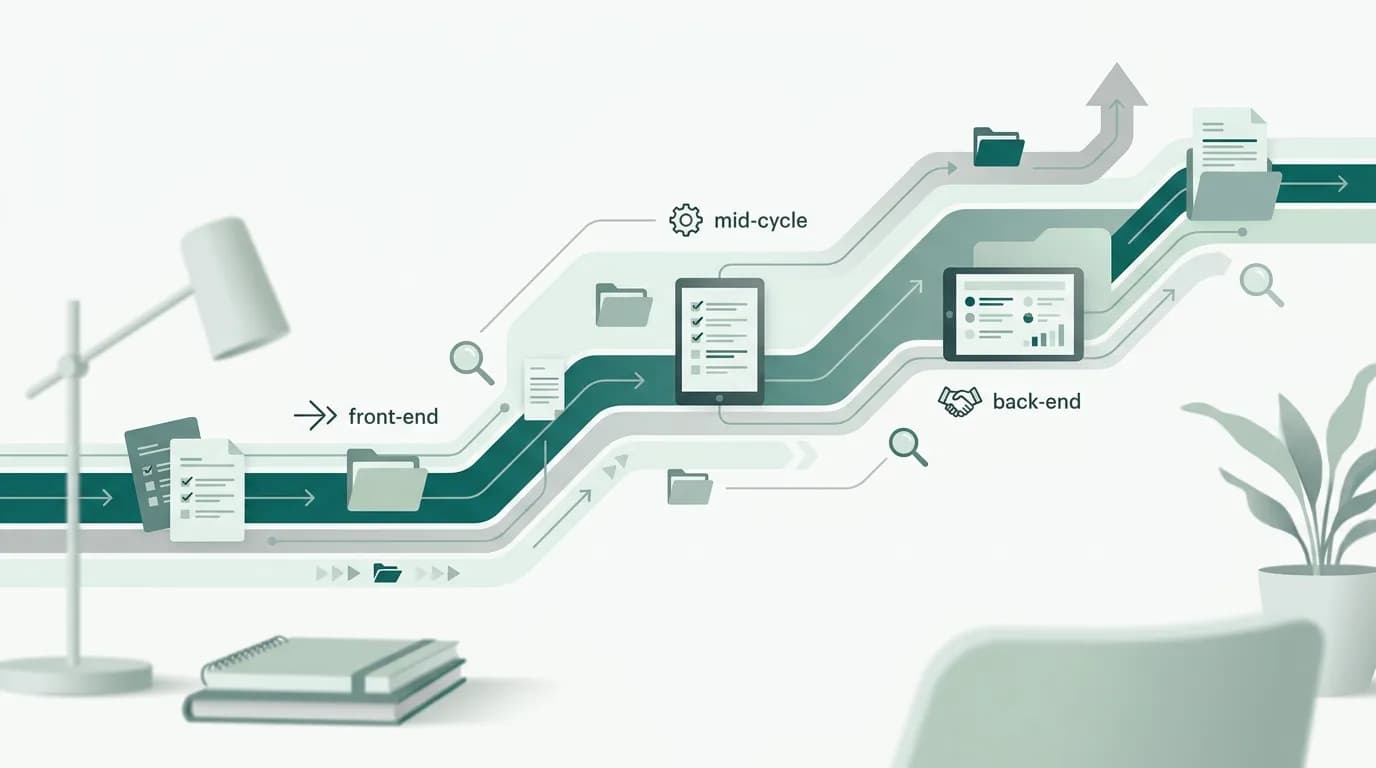
Revenue cycle work starts before a claim is created and continues until the account is resolved. Front-end roles handle scheduling, registration, insurance verification, prior authorization, estimates, and patient financial communication. Mid-cycle roles focus on documentation, charge capture, coding, claim edits, and clean-claim preparation. Back-end roles handle payment posting, follow-up, denials, appeals, patient balances, and account resolution. Analyst and improvement roles look across those handoffs for recurring problems. This map matters more than title alone: two “revenue cycle specialist” jobs can sit at different points and require different experience.
Four credible entry points — and what each teaches
Patient access teaches eligibility, authorization, registration accuracy, and how early errors affect later payment. Medical billing teaches claim submission, payer rules, payment posting, account notes, and follow-up. Coding or charge-entry work builds knowledge of documentation, code sets, edits, and how clinical records become billable services. Customer service or patient financial services builds account explanation, payment conversations, escalation, and resolution skills. None is the universal starting point. Choose the entry point closest to experience you can already prove, then learn what happens immediately before and after your queue. For a closer comparison of two common starting areas, read medical billing vs revenue cycle jobs.
The first useful move is usually sideways, not upward
A lateral move can add more range than a title change. A biller might move into denials to learn root-cause analysis and appeals. A patient access representative might move into authorization, financial clearance, or quality review. A coder might move into coding audit, clinical documentation integrity, or revenue integrity. A payment poster might move into reconciliation or payer follow-up. The strongest move is one that exposes you to a new handoff, new evidence, or a new system while preserving skills you already use. Before applying, identify the next process you want to own—not just the next title.
What changes when you move into analyst or improvement work
Queue-based roles ask whether an account was handled correctly. Analyst and improvement roles ask why the same problem keeps appearing. They may segment denials, trace registration or authorization failures, review work queues, validate reports, map workflows, test fixes, and explain findings to patient access, coding, clinical, finance, or IT teams. To prepare, keep examples of how you found a pattern, checked the underlying records, separated symptoms from causes, and measured whether a change held. Spreadsheet fluency helps, but defensible analysis also requires clean definitions, careful sampling, and enough operational knowledge to avoid drawing conclusions from a dashboard alone.
Choose education and credentials for the work you want
Credentials are role-specific signals, not automatic promotions. AAPC describes its CPB credential around billing, claim submission, payer rules, denials, appeals, payment posting, and revenue cycle workflows. HFMA places patient access training, denial prevention, and its CRCR credential within a broader revenue cycle pathway; its current pathway recommends CRCR for staff with at least one year of revenue cycle experience. Coding, health information, analytics, privacy, or finance roles may point to different education. Read several target postings first, note which credential is repeatedly required or preferred, and confirm current eligibility directly with the issuing organization before paying for training.
Build evidence for the next role before changing your résumé title
Hiring managers can evaluate evidence more easily than ambition. Track examples such as a queue you kept accurate, a denial category you investigated, a registration defect you helped correct, an appeal packet you assembled, a report you reconciled, or a process note you improved. Remove patient identifiers and confidential employer data. Describe the problem, the records or rules you checked, who owned the decision, what you changed, and how completion was confirmed. If your current role is narrow, ask to observe an adjacent team, join a small quality review, document a handoff, or learn the report used to measure your queue. Then compare those examples with current healthcare administration openings and apply where the next scope is visible in the responsibilities.
Questions that reveal whether a role is a real next step
Ask which part of the cycle the role owns, which work queues and systems it uses, and which teams sit immediately upstream and downstream. Clarify whether the job corrects individual accounts or investigates recurring causes; whether it produces reports or is expected to interpret them; and whether coding, payer, contract, clinical, or compliance questions are escalated to specialists. Ask how quality is reviewed and what someone in the role should be able to handle independently after six months. Clear answers show the actual learning opportunity. Vague answers built around “all revenue cycle duties” may hide a role with little support or an unmanageably broad scope.