Home / Blog / Revenue Cycle
Revenue Cycle
Medical Billing AR Follow-Up Jobs: Read the Claim Queue
AR follow-up is not just calling payers about old claims. The job is to establish what happened, choose the correct resolution path, and leave a defensible account record for the next handoff.
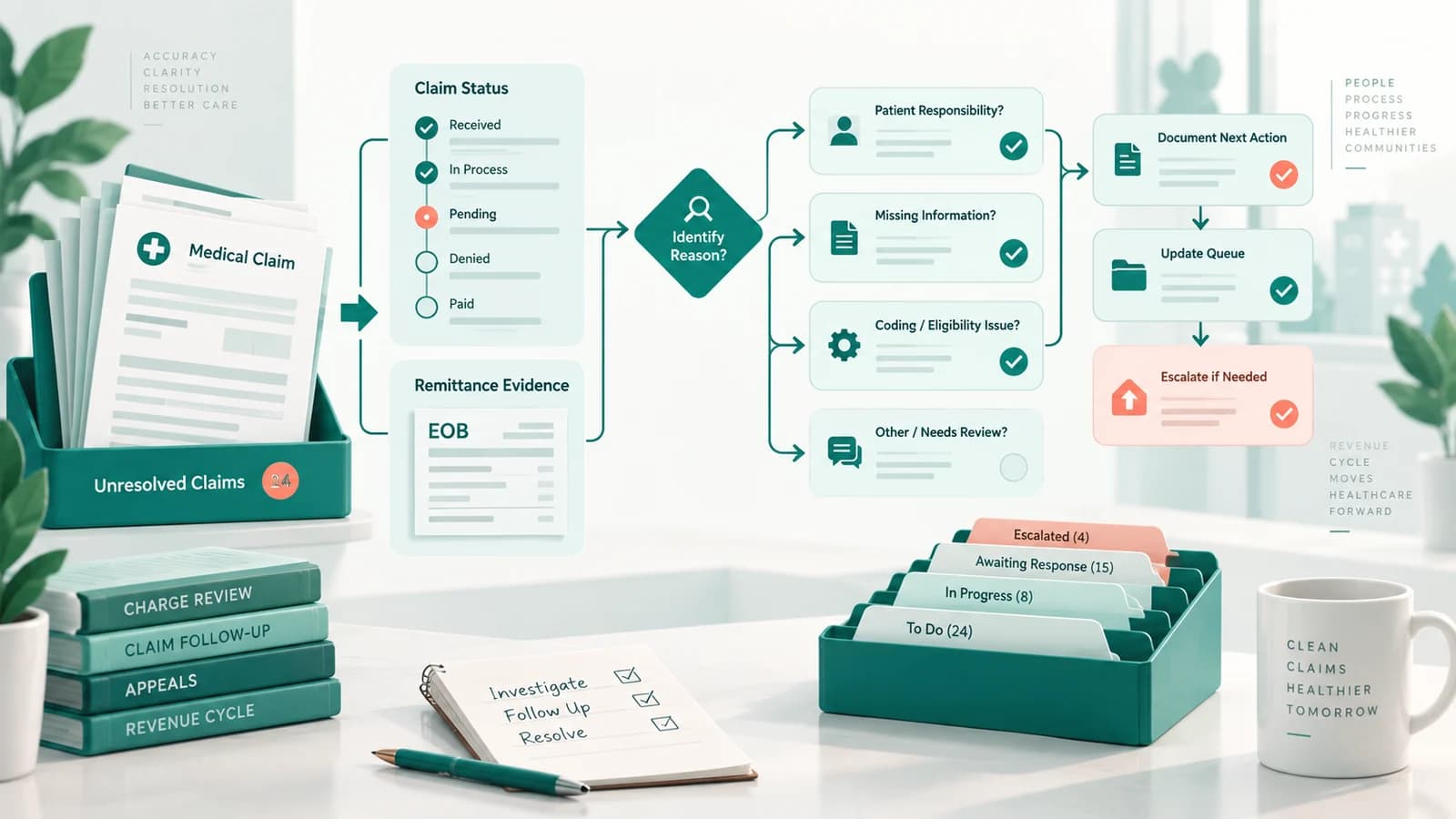
The queue starts with an unresolved balance, not one standard problem
An aged balance can represent a claim that was never accepted, a claim still pending, a request for information, a denial, an underpayment, a payment posted incorrectly, or an amount that should move to another responsible party. That is why a strong follow-up specialist does not begin with the same payer call for every account. The first task is to reconstruct the claim state from submission records, acknowledgements, payer portals, remittance details, account notes, and the current balance. Beth Israel Lahey Health's current hospital-billing vacancy separates billing, denial, and follow-up work queues while requiring the representative to review the full account before moving or adjusting a balance.
Use a five-question claim investigation
For each account, establish five things in order: Was the claim accepted into adjudication? What is its current status? Has a final remittance been issued? Who owns the next action? What evidence will close the loop? CMS describes electronic 276/277 transactions as a request-and-response method for obtaining claim status from Medicare Administrative Contractors, while its Medicare remittance guidance explains that an ERA or paper remit reports final adjudication, adjustments, and financial responsibility at claim or service-line level. In practice, the next action may be waiting to a documented follow-up date, correcting and resubmitting a rejected claim, supplying records, requesting reprocessing, preparing an appeal, fixing a posting error, or escalating a recurring payer issue.
Claim status and remittance details answer different questions
A claim-status response tells you where a submitted claim sits; a remittance explains the result after adjudication. Do not treat either as a complete root-cause analysis. CMS notes that Medicare remittances use group codes, Claim Adjustment Reason Codes, and Remittance Advice Remark Codes to explain adjustments and responsibility. Those details identify what the payer reported, but the specialist may still need to compare the original claim, eligibility or authorization records, clinical documentation, coding, contract terms, and prior account activity before choosing an action. A posting that expects this investigation is broader than one limited to checking status and setting another follow-up date.
The account note is part of the work product
Baptist Memorial Health Care's current AR follow-up posting requires specialists to record payment status, actions taken, requested documents, the next follow-up timing, and payer-requirement changes in the patient account. It also expects repetitive denials to be reported for corrective action. A useful note should let another specialist answer: what was checked, what the payer or internal team said, what evidence was sent or corrected, who now owns the account, what deadline applies, and when it should return to the queue. Vague notes such as “called payer” hide the decision and force the next person to repeat the investigation.
Decode scope before you apply
Search the posting for its dominant unit of work. “Claim edits,” “rejections,” and “resubmit” point toward front-end billing correction. “Aging,” “payer portal,” “unpaid claims,” and “next follow-up date” indicate insurance follow-up. “CARC/RARC,” “appeals,” and “medical records” suggest denial resolution. “ERA,” “adjustments,” “reconciliation,” and “unapplied cash” indicate payment posting or cash work. “Payer trends,” “root cause,” and “system correction” add an analyst or improvement layer. Compare those boundaries with medical billing versus revenue cycle roles, the deeper denials management guide, and the revenue cycle career path. Then review current healthcare administration jobs and set job alerts for AR follow-up, insurance follow-up, patient financial services, and billing representative titles.