Home / Blog / Revenue Cycle
Revenue Cycle
Prior Authorization Specialist Jobs: Decode the Work Queue
Prior authorization titles can hide very different queues. The safest way to compare them is to trace who starts the request, who supplies evidence, who makes the clinical decision, and who owns the follow-up.
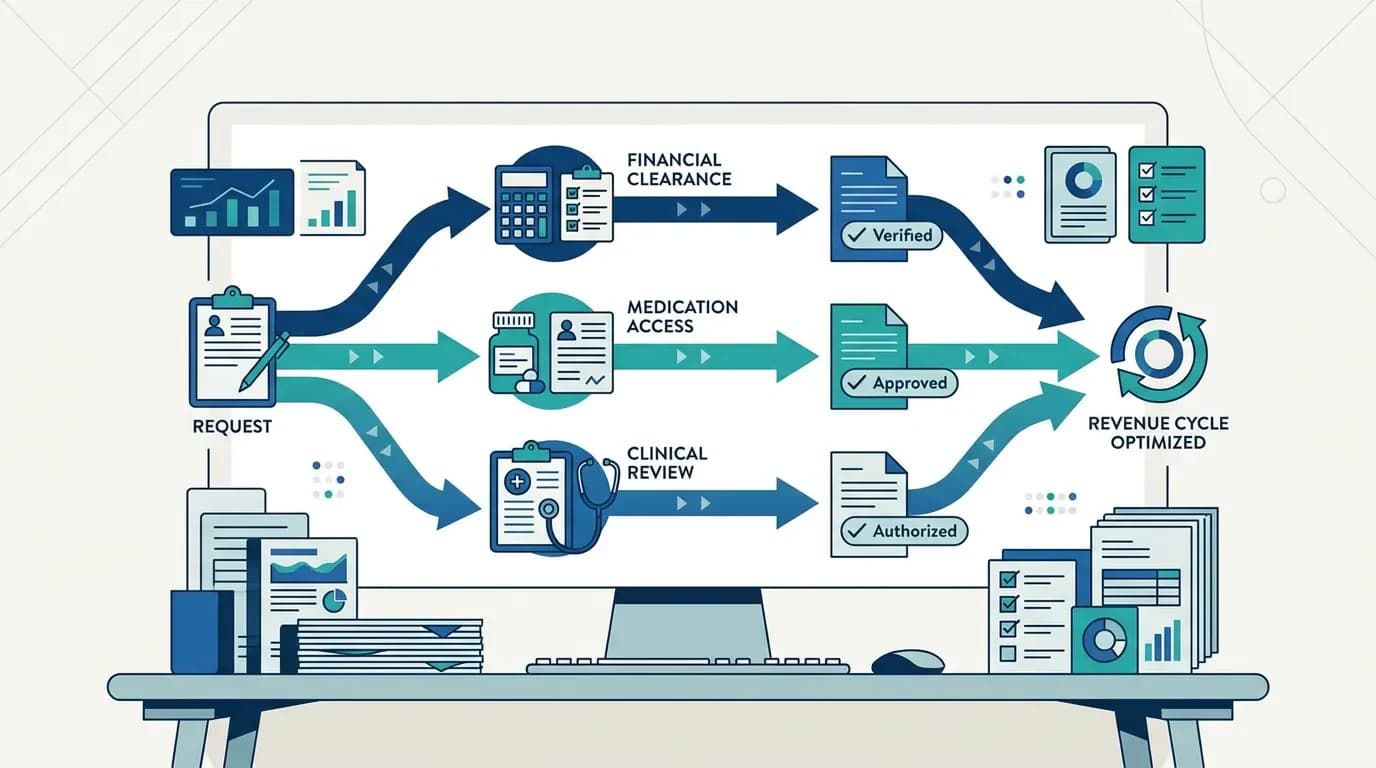
Map the request before judging the title
A provider-side prior authorization specialist usually verifies coverage, identifies whether authorization is required, gathers the payer-specific information, submits the request, tracks the response, and documents the result before a service or medication moves forward. Beth Israel Lahey Health's current financial-clearance role combines eligibility, medical-necessity checks, payer protocols, work queues, escalation, and communication with clinical departments. Cook County Health's standard role adds urgent requests, denials, appeals, and peer-to-peer setup. The title alone does not tell you which of those steps dominates, so read the posting as a request path rather than a duty list.
Use four gates to decode the queue
First, identify the trigger: a scheduled procedure, referral, admission, medication, or continuation of care. Second, identify the evidence: demographics, benefits, procedure and diagnosis codes, clinical notes, medication history, or payer forms. Third, identify the decision owner. An administrative specialist may assemble and track the request while a payer clinician or medical director applies clinical criteria. Fourth, identify the exception path: missing records, non-covered benefits, denial follow-up, appeal support, or peer-to-peer review. A strong posting states what you may resolve yourself and what must be escalated.
Separate provider, pharmacy, and clinical-review lanes
Provider financial-clearance roles often sit before outpatient services and emphasize eligibility, CPT/HCPCS and diagnosis-code context, payer portals, deadlines, and coordination with scheduling or clinical departments. Pharmacy or medication-access roles can add prescription benefits, medication histories, refill workflows, financial-support eligibility, and communication with pharmacists and prescribers; Ochsner's current medication-access posting is one example. Payer-side utilization-management or review roles can require a clinical license and authority to apply clinical criteria. Do not treat these as interchangeable just because each posting contains “prior authorization.”
Treat documentation as a decision trail
The core work product is not merely an approval number. It is a traceable record of the requirement checked, information submitted, contacts attempted, response received, dates, unresolved gap, and next owner. CMS's current prior-authorization rules for specified impacted payers reinforce the importance of explicit responses, denial reasons, request-for-information paths, decision timing, and aggregated process measures. Those federal provisions do not govern every payer or every authorization queue in the same way, but they make a useful interview lens: ask how the team records status, missing evidence, turnaround time, denials, and escalations.
Build evidence without overstating clinical authority
Create a fictional workflow sample with no patient information: receive a scheduled-service request, verify the plan and benefit, identify the payer rule, list the documents needed, record each submission and follow-up, then route a clinical question to the correct reviewer. Add a small posting matrix that compares trigger, evidence, systems, decision owner, exception path, and work setting across five target roles. This demonstrates queue control and careful escalation without claiming that you can make a medical-necessity determination when the job reserves that decision for licensed staff.
Choose the closest entry lane
Patient access experience can transfer when you already verify eligibility, collect accurate registration data, or coordinate scheduled services. Billing and revenue-cycle experience can transfer through payer rules, coding context, denial follow-up, and documentation discipline. Pharmacy support can fit medication-access queues when the posting's training or certification requirements match your background. Compare the patient access and patient accounts handoff, place authorization work within the revenue cycle career path, and use the denials management guide for the downstream exception lane. Then review current healthcare administration jobs and set job alerts for the exact setting and requirements you can support.